day three of seven of the social bobcat's goaltending camp is in the books, and it brought..... pretty much more of the same: drills, drills, drills.
this past monday's camp focused primarily on two different aspects of goaltender movement: telescoping and shuffling.
Telescoping
telescoping is the act of moving out toward the puck or backwards toward the net and is the cornerstone of good gap control.
in a standard goaltending matchup (goaltender vs. single attacker) you can think of there being two "gaps" in play: the distance between the puck and the goaltender and the distance between the goaltender and the goal itself. (or think of a straight line from the goal, A, to the puck ,C, with the goaltender as some point, B, between the two)
the greater the distance between the puck and the goaltender, the more time the goaltender has to react to a shot on goal. to an extreme, if the goaltender planted his feet on the goal line the goaltender-to-puck gap would be maximized all the time and the goaltender would always have the most time possible to react to a shot. this method wouldn't be too practical, however, as a standard goal measures four feet high by six feet across; most people can't fill up twenty-four square feet of space, bulky protective gear or not, leaving numerous large holes for shooters to target. with the speed that hockey pucks can achieve, playing a 100% reaction-based goaltending style won't get you too far, sometimes you need to just be a wall that the puck hits.
the way to reduce these holes is through, you guessed it, adjustment of the goaltender-to-goal gap. as you travel farther out from your net toward the puck your body covers more of the net, same as how holding your hand up to your face covers more of your computer monitor than if you place your hand against the screen.
the trick in proper gap control is to figure out just how far you need to be from the goal and from the puck at any given moment. you want to be out from the goal far enough to reduce the amount of the goal that the shooter can see (called "cutting down the angle") but don't want to be so far out that you overcommit to the current puckcarrier (mind you, there are usually four other guys in the zone who would also endeavor to put the puck past you into the net).
visualize a triangle between the puck and the two goal posts: the puck can be shot on a line anywhere inside of this triangle and, unless impeded in some way, a goal will result (unless of course it's shot over the top of the net itself).
Your friendly neighborhood goaltender can maximize his level of coverage without overcommitting to the puck's current position by telescoping out to where his body touches the edges of the triangle (for most modern-style goalies, where the feet would touch the triangle edges while in the butterfly position). By doing this the netminder can ensure that a puck shot on net will at least be in reach of his limbs, upper or lower, giving him a chance to make the save; a puck shot any wider will miss the net entirely.
So what have we learned? Telescoping is great and a good example of geometry and physics in the real world. But.... it doesn't get the save made by itself.
Shuffling
I've found that opponents have the nasty habit of not staying still while play is going on; one guy moves around the attacking zone to my left with the puck or passes it to another guy in the center of the zone who passes it off to yet another guy down to my right or maybe back to the first guy on the left. They keep changing the size and shape of my puck-to-posts triangle! It's really quite impolite as it requires me to make sudden changes in my physical location and angle as well; with all that gear on it can get quite tiring.
When making these positional changes, the goaltender wants to maintain the uniformity of his stance and be "square to the puck" (meaning he is between the puck and the goal with his body perpendicular to the line between the puck and the center of the goal line); this maximizes the surface area width of the body between the puck and goal. since shots can be fired on net at any time, it's best to be ready for a shot at any time and in the right position. if you moved to your left by turning your hips to face the new spot you wanted to be in, you'd open up a lot of net and also not be ready to react to a shot; the way to move around and stay ready is to shuffle like a madman (assuming that madmen shuffle in the way i'm about to describe).
Shuffling is nothing more than facing forward and pushing off to the side with your right skate (to move left) or left skate (to move right). The goalie does this motion from his crouch stance and the upper torso remains motionless; all movement is from the hips down. With a series of small quick shuffles the goaltender can track the puck around the zone while maintaining a solid mass between the puck and the net. of course, on some long-range passes where the angle of attack changes sharply the goalie must abandon the shuffle and make a quick skate over to the new puck location, but for the most part the shuffle is his bread n' butter.
so there you have it, making saves is as easy as telescoping out and back to adjust to the puck's distance from the net and shuffling laterally to accomodate for the angle of the puck relative to the net.
..... and maintaining proper stance and balance.....and monitoring the puckcarrier while noting the locations of the other opponents in the zone.....and noting the locations of your own teammates in the zone.... and tracking an inch-wide , 3" diameter cylinder in flight and telling your various limbs what to do to stop it..... simple!
(and hence my attendance at goalie school)
Monday, May 01, 2006


still waiting..
a brief note here:
i don't know if the hiatus, the introduction of American Dad, or some other factor is to blame but another Sunday passes and i'm still waiting for Family Guy to be cleverly funny again, as in the days before it was canceled and brought back to life by DVD sales and Cartoon Network reruns. the first episode when they came back was great (i recall a subplot with Mel Gibson) but the quality has been steadily rolling downhill since that point.
i still DVR every episode and watch but i wonder how long it'll be before Seth and his crew make me stop caring about Family Guy the way my enthusiasm for the Simpsons eventually waned into nothingness.
i don't know if the hiatus, the introduction of American Dad, or some other factor is to blame but another Sunday passes and i'm still waiting for Family Guy to be cleverly funny again, as in the days before it was canceled and brought back to life by DVD sales and Cartoon Network reruns. the first episode when they came back was great (i recall a subplot with Mel Gibson) but the quality has been steadily rolling downhill since that point.
i still DVR every episode and watch but i wonder how long it'll be before Seth and his crew make me stop caring about Family Guy the way my enthusiasm for the Simpsons eventually waned into nothingness.
Monday, April 24, 2006
Vanity, thy name is license plate
ok people, anybody have any insights into the minds of people who thrill to the idea of having vanity license plates on their cars?
to me, the concept of a vanity plate has its own tinge of egotism right out of the gate, trying to make some personal declaration in seven letters or less to make your mass-produced car 'unique'. seems the people who are as drawn to this medium of expression as moths are to the flame are generally (or at least appear to be, as far as i can tell from their stamped-metal communique) elitist snobs or "wooo! PARTY "a-holes or some combination of the two.
you've all seen 'em: license plates like RICH DR on a Mercedes, 2FAST4U on a Mustang or 58 MPG on a Prius hybrid, something that says, "generic traffic audience, i feel that my status/condition is in this specific way superior to yours...i am trumpeting my awesomeness to the world!".
the notion was recently brought to mind by the presence of two separate vanity plates in my apartment complex this past weekend.
Vanity Plate the First: "BAK OFF" , as seen on a black(?) Porsche Boxster.
now you'd expect the driver of a small, sporty car to center his license phrase more around the near-mythical levels of speed and handling that his car grants him but this particular owner strangely decided to go with an "i'm a badass" theme you'd normally see on a 4x4 pickup jacked up on huge tires. i don't want to imply that this combination of car and plate points to one or more personal insecurities but... hmm, i don't know how to end that thought.
another element worthy of mention here is that the driver obviously wanted to brand his driving experience with this phrase so badly that he was not deterred when he found that the correct spelling variant "BACK OFF" was already taken.
Vanity Plate the Second: "NOWUSE", as seen on a blue Toyota Supra (with big spoiler and exhaust pipe? you bet!)
i assume that the message here is intended to be "No Wussy" (unless we're actually being encouraged to 'now use' some unspecified product); what is unclear is whether the driver is stating that he himself is not a wussy or that wussies (wusses?) should refrain from challenging him and his ride in any racing competitions, the outcome of which would surely result in their embarrassing defeat (and further sprial into greater depths of wussydom).
i, of course, could very well be wrong about these particular drivers (and maybe the others as well); they could be great people, caring parents, conscientious community members. still, i can't say i'd ever envision Mother Theresa having driven around from one charitable mission to the next sporting a "2HOLY4U" plate.
to me, the concept of a vanity plate has its own tinge of egotism right out of the gate, trying to make some personal declaration in seven letters or less to make your mass-produced car 'unique'. seems the people who are as drawn to this medium of expression as moths are to the flame are generally (or at least appear to be, as far as i can tell from their stamped-metal communique) elitist snobs or "wooo! PARTY "a-holes or some combination of the two.
you've all seen 'em: license plates like RICH DR on a Mercedes, 2FAST4U on a Mustang or 58 MPG on a Prius hybrid, something that says, "generic traffic audience, i feel that my status/condition is in this specific way superior to yours...i am trumpeting my awesomeness to the world!".
the notion was recently brought to mind by the presence of two separate vanity plates in my apartment complex this past weekend.
Vanity Plate the First: "BAK OFF" , as seen on a black(?) Porsche Boxster.
now you'd expect the driver of a small, sporty car to center his license phrase more around the near-mythical levels of speed and handling that his car grants him but this particular owner strangely decided to go with an "i'm a badass" theme you'd normally see on a 4x4 pickup jacked up on huge tires. i don't want to imply that this combination of car and plate points to one or more personal insecurities but... hmm, i don't know how to end that thought.
another element worthy of mention here is that the driver obviously wanted to brand his driving experience with this phrase so badly that he was not deterred when he found that the correct spelling variant "BACK OFF" was already taken.
Vanity Plate the Second: "NOWUSE", as seen on a blue Toyota Supra (with big spoiler and exhaust pipe? you bet!)
i assume that the message here is intended to be "No Wussy" (unless we're actually being encouraged to 'now use' some unspecified product); what is unclear is whether the driver is stating that he himself is not a wussy or that wussies (wusses?) should refrain from challenging him and his ride in any racing competitions, the outcome of which would surely result in their embarrassing defeat (and further sprial into greater depths of wussydom).
i, of course, could very well be wrong about these particular drivers (and maybe the others as well); they could be great people, caring parents, conscientious community members. still, i can't say i'd ever envision Mother Theresa having driven around from one charitable mission to the next sporting a "2HOLY4U" plate.
Thursday, April 20, 2006
Goalie camp - day two
week two of The Goaltending Miseducation of the Social Bobcat started with me and my fellow goalie tutees being split up in mini-groups between four different stations:
1) butterfly save drill - assume the butterfly position (for those that aren't in the know, this is the save selection that positions the knees together and legs splayed in a manner that has no practical value other than within the narrow confines of hockey, see here) in front of the goal and proceed to direct low shots out of harm's way with the leg pads; the second portion of the drill had the shooters taking shots in any direction and height, to test your ability to make reaction-saves from the otherwise blocking position
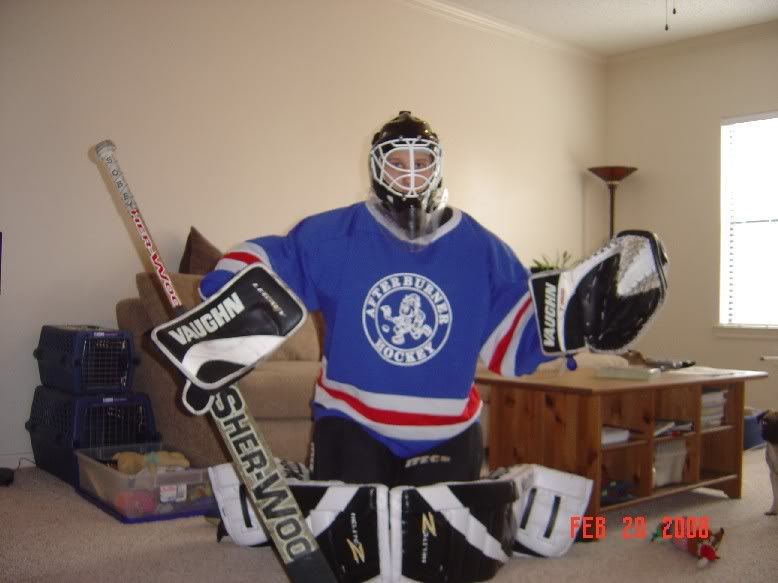
2) shooter ID drill - goalie sets up facing his own goal with his back to two shooters; on command, goalie turns around and looks for the shooter with his stick raised, then advances out to cut down the angle of his shot on net.
3) pokecheck drill - goalie stands in front of his goal; three pucks lie on the ice about fifteen feet away. on command, goalie skates hard out to the pucks and executes a diving pokecheck, sliding on his stomach and knocking the puck a good distance away with the blade of the stick. goalie must then skate backwards to his crease and repeat until all pucks are properly dispatched. goalie must then skate backwards and cut off the angle of a shooter to the side of the net who fires three quick shots that the goalie must ward off.
4) post-to-post drill - with two shooters about fifteen feet out and on opposite sides of the net, goalie practices shuffling sideways from post to post, then advances out from the right post to the shooter on the left, or vice versa, to cover a shot on net.
As luck would have it, I got pegged to start the drill cycle in the most exhausting of them all, #3 pokecheck drill , or as i call it , "the Social Bobcat comedy routine"; i think on my first run through i whiffed on all three pucks that i was supposed to have elegantly directed away from danger. this is not a move that i have practiced much or utilized often in a game; to grasp the coordination of motion required, think of it as a one-handed pool cue shot executed while you're sliding on your stomach.
to make matters worse the coaches at that station decided that on our second time through we had to begin the drill by dropping on our stomachs and rolling over before getting back up to race out and jab at the pucks; i fared better on the puckstriking the second time around (got 2 out of 3) but was so winded at the end that i really didn't get back on angle to the shooter who was firing pucks at the net.
the other drills went fine (with the exception of one yahoo in my group at the #2 shooter ID drill who didn't seem to understand the concept of taking his turn for a decent number of shots and then stepping out to let others have a go at it.
i think Wilkie is doing a good job with introducing various drills but i do think that one of the first couple of sessions could have included the basics: mechanics of a good stance, butterfly recovery, etc.; i don't know about the rest of the students but i'm looking for a personal evaluation and discussion at some point, not just to be a participant in a goalie obstacle course. Will have to wait and see if we get some of that personal instruction later on.... if not i don't know if i'm going to get out of this camp what i was looking for.
1) butterfly save drill - assume the butterfly position (for those that aren't in the know, this is the save selection that positions the knees together and legs splayed in a manner that has no practical value other than within the narrow confines of hockey, see here) in front of the goal and proceed to direct low shots out of harm's way with the leg pads; the second portion of the drill had the shooters taking shots in any direction and height, to test your ability to make reaction-saves from the otherwise blocking position
2) shooter ID drill - goalie sets up facing his own goal with his back to two shooters; on command, goalie turns around and looks for the shooter with his stick raised, then advances out to cut down the angle of his shot on net.
3) pokecheck drill - goalie stands in front of his goal; three pucks lie on the ice about fifteen feet away. on command, goalie skates hard out to the pucks and executes a diving pokecheck, sliding on his stomach and knocking the puck a good distance away with the blade of the stick. goalie must then skate backwards to his crease and repeat until all pucks are properly dispatched. goalie must then skate backwards and cut off the angle of a shooter to the side of the net who fires three quick shots that the goalie must ward off.
4) post-to-post drill - with two shooters about fifteen feet out and on opposite sides of the net, goalie practices shuffling sideways from post to post, then advances out from the right post to the shooter on the left, or vice versa, to cover a shot on net.
As luck would have it, I got pegged to start the drill cycle in the most exhausting of them all, #3 pokecheck drill , or as i call it , "the Social Bobcat comedy routine"; i think on my first run through i whiffed on all three pucks that i was supposed to have elegantly directed away from danger. this is not a move that i have practiced much or utilized often in a game; to grasp the coordination of motion required, think of it as a one-handed pool cue shot executed while you're sliding on your stomach.
to make matters worse the coaches at that station decided that on our second time through we had to begin the drill by dropping on our stomachs and rolling over before getting back up to race out and jab at the pucks; i fared better on the puckstriking the second time around (got 2 out of 3) but was so winded at the end that i really didn't get back on angle to the shooter who was firing pucks at the net.
the other drills went fine (with the exception of one yahoo in my group at the #2 shooter ID drill who didn't seem to understand the concept of taking his turn for a decent number of shots and then stepping out to let others have a go at it.
i think Wilkie is doing a good job with introducing various drills but i do think that one of the first couple of sessions could have included the basics: mechanics of a good stance, butterfly recovery, etc.; i don't know about the rest of the students but i'm looking for a personal evaluation and discussion at some point, not just to be a participant in a goalie obstacle course. Will have to wait and see if we get some of that personal instruction later on.... if not i don't know if i'm going to get out of this camp what i was looking for.
Tuesday, April 18, 2006
My office's restroom design defies the natural laws of men's restrooms!
The men's restroom in my employer's office has a critical flaw in its design: two urinals.
As any conscientious male knows, there are certain buffer zones of personal space that should be honored when concerning the act of relieving one's bladder.
For example, if you enter a three-urinal restroom and find all unoccupied, you would select either the leftmost or rightmost station; this allows any subsequent urinator to occupy the urinal on the far opposite side. In this way proper proximities are established and each man can go about his business in a relaxed state.
What if, you say, you enter a three-urinal restroom and find stations 1 and 3 occupied? The buffer zone rule can actually be waived here; it is acceptable to use the middle station #2 because, in this case, there are not one but two other persons besides you in the immediate area so the unnerving "it's just you and me" effect is no longer a factor. Still, if I encounter this setup I generally move on to any unoccupied toilet stalls as I consider it the most courteous option.
There are many more established rules (different variants of "# of stalls vs. # of occupants") but they're too lengthy to discuss here; back to my office situation.
The problem with my office's design is that the two-urinal setup eliminates entirely the buffer-zone or multi-person options; they might as well have just installed only one urinal as the second one is effectively rendered ineligible for simultaneous usage under the proper guidelines.
To make matters worse, the area in which these two urinals are stationed is enclosed by thick walls on either side, further amplifying the "too cozy two-person" factor and increasing the chances of "can't-pee" syndrome when you step up to one of the stations in the otherwise empty set and someone else, ignorant of the rules, sidles up to the other station shortly thereafter.
"Can't-pee" syndrome, or "inrelievicus latrinum stat", is one of the world's true Catch-22's: you need to relax to put an end to the syndrome but every palpable second in which the syndrome is in effect raises the awareness of its existence to both you and your unwanted urinalmate, thereby raising social discomfort and preventing the necessary relaxtion process.
In addition, more of my coworkers than what I would have imagined seem to be unaware of the basic rules; because of the greater potential for sidling urinalmates I am thinking of bypassing the urinal section entirely in favor of the toilet areas during future visits.
As any conscientious male knows, there are certain buffer zones of personal space that should be honored when concerning the act of relieving one's bladder.
For example, if you enter a three-urinal restroom and find all unoccupied, you would select either the leftmost or rightmost station; this allows any subsequent urinator to occupy the urinal on the far opposite side. In this way proper proximities are established and each man can go about his business in a relaxed state.
What if, you say, you enter a three-urinal restroom and find stations 1 and 3 occupied? The buffer zone rule can actually be waived here; it is acceptable to use the middle station #2 because, in this case, there are not one but two other persons besides you in the immediate area so the unnerving "it's just you and me" effect is no longer a factor. Still, if I encounter this setup I generally move on to any unoccupied toilet stalls as I consider it the most courteous option.
There are many more established rules (different variants of "# of stalls vs. # of occupants") but they're too lengthy to discuss here; back to my office situation.
The problem with my office's design is that the two-urinal setup eliminates entirely the buffer-zone or multi-person options; they might as well have just installed only one urinal as the second one is effectively rendered ineligible for simultaneous usage under the proper guidelines.
To make matters worse, the area in which these two urinals are stationed is enclosed by thick walls on either side, further amplifying the "too cozy two-person" factor and increasing the chances of "can't-pee" syndrome when you step up to one of the stations in the otherwise empty set and someone else, ignorant of the rules, sidles up to the other station shortly thereafter.
"Can't-pee" syndrome, or "inrelievicus latrinum stat", is one of the world's true Catch-22's: you need to relax to put an end to the syndrome but every palpable second in which the syndrome is in effect raises the awareness of its existence to both you and your unwanted urinalmate, thereby raising social discomfort and preventing the necessary relaxtion process.
In addition, more of my coworkers than what I would have imagined seem to be unaware of the basic rules; because of the greater potential for sidling urinalmates I am thinking of bypassing the urinal section entirely in favor of the toilet areas during future visits.
Wednesday, April 12, 2006
The Social Bobcat goes to camp!
I've been amateurishly goaltending for about seven years now and in that time any development in the art and form of preventing cylindrical objects from entering a netted area has been solely due to my own trial-and-error process and a couple of books read on the subject.
There are numerous aspects to playing the position - stance, angles, depth, gap control, to name a few - and I've always felt that since the only teacher I've ever had (myself) is far from a master in the subject I could benefit from getting told how it is by someone with a few more years in the game than me.
Normally this hasn't really been an option. To clear up a common misconception, Texas (outside of Dallas at least) is not exactly a hotbed of hockey activity; further to that point, the goaltending population is a narrower niche than the regular player population so goaltender-specific training camps are few and far between. When there are any scheduled in nearby areas they're usually week-long all-day affairs; since I'm a working stiff with an 8 to 5 job those camps, while they would be beneficial, are generally ruled out unless I chose to spend half of my vacation days on one (plus they tend to cost a lot of money).
So for years I toiled alone and begged, borrowed, stole as much technique as I could from printed material and by observing other goalies around me. Fate did dole out some kindness to me recently, though, in that the rink where I play brought in a former minor pro goalie to teach a mini-camp of sorts for seven weeks, every Monday for 1 - 1 1/2 hours in the evenings after work.
This past Monday was the first session; I was a bit surprised that the South Houston area managed to produce eleven others besides me who craved goaltending wisdom. About half of them seem to be high-school age and younger; no five-or-six-year-olds in attendance which was a little disappointing as little tykes in goaltending gear are pretty cute and funny to watch. evidence shown here:


Watch that five-hole, little guy!
The instructor, Paul "Wilkie" Wilkinson, has been playing since age five and was at one time a deprecatingly self-described "door-opener" in the big leagues (read: perennial backup goaltender who sits by the bench door and doesn't play unless the first-string netminder is out). Seems like a good guy who really likes the sport and wants to help us out; still, I don't expect him to be a miracle-worker with me, the guy only has seven combined hours to play goalie doctor and he has eleven other puck-targets to work with. He does seem to have things organized, though; lesson plans have been promised before each day's session and some time off the ice afterwards to discuss drills , skills, and what have you.
First day was pretty general; we split up into four groups of three for some basic stick deflection drills (shooters shoot low to each side and goalie has to redirect the puck to the corner, then shooters shoot high and the goalie has to catch, drop, and redirect on the glove side or redirect in the air on the blocker side). After that some endurance drills that left me a little out of breath by the end of it; nothing like five quick up-and-down butterfly saves followed by a sprint to the center red-line and another up-and-down butterfly cycle.
At the end of the session we divided the group in half and started doing shootouts, with the shooters skating in on the goalie in net and endeavoring to score. As long as the goalie kept turning pucks away he could stay; once one got by, he's out and time for the next guy to test his mettle against the encroaching snipers. I did pretty well on this; during my two stints in net i turned away about three or four each time , either through an active save or playing my angles/depth well enough to force shots wide.
After the session, Wilkie said he'd like to be able to learn more about each of us and to that end we could send him an email about our backgrounds and desired goals for the camp. He may have regretted making that offer as I put together a mammoth 1,955 word essay on my background, perceived strengths/weaknesses, and goals; he's yet to respond, hopefully due more to lax e-mail checking than to me having freaked him out with my enthusiasm.
Will post updates as the weeks (and my l33t g0ali3 ski11z) progress.
There are numerous aspects to playing the position - stance, angles, depth, gap control, to name a few - and I've always felt that since the only teacher I've ever had (myself) is far from a master in the subject I could benefit from getting told how it is by someone with a few more years in the game than me.
Normally this hasn't really been an option. To clear up a common misconception, Texas (outside of Dallas at least) is not exactly a hotbed of hockey activity; further to that point, the goaltending population is a narrower niche than the regular player population so goaltender-specific training camps are few and far between. When there are any scheduled in nearby areas they're usually week-long all-day affairs; since I'm a working stiff with an 8 to 5 job those camps, while they would be beneficial, are generally ruled out unless I chose to spend half of my vacation days on one (plus they tend to cost a lot of money).
So for years I toiled alone and begged, borrowed, stole as much technique as I could from printed material and by observing other goalies around me. Fate did dole out some kindness to me recently, though, in that the rink where I play brought in a former minor pro goalie to teach a mini-camp of sorts for seven weeks, every Monday for 1 - 1 1/2 hours in the evenings after work.
This past Monday was the first session; I was a bit surprised that the South Houston area managed to produce eleven others besides me who craved goaltending wisdom. About half of them seem to be high-school age and younger; no five-or-six-year-olds in attendance which was a little disappointing as little tykes in goaltending gear are pretty cute and funny to watch. evidence shown here:
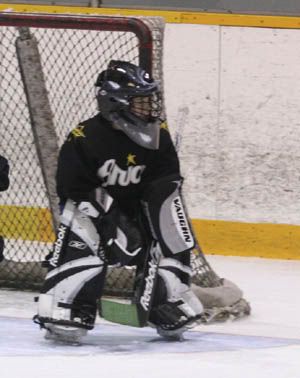
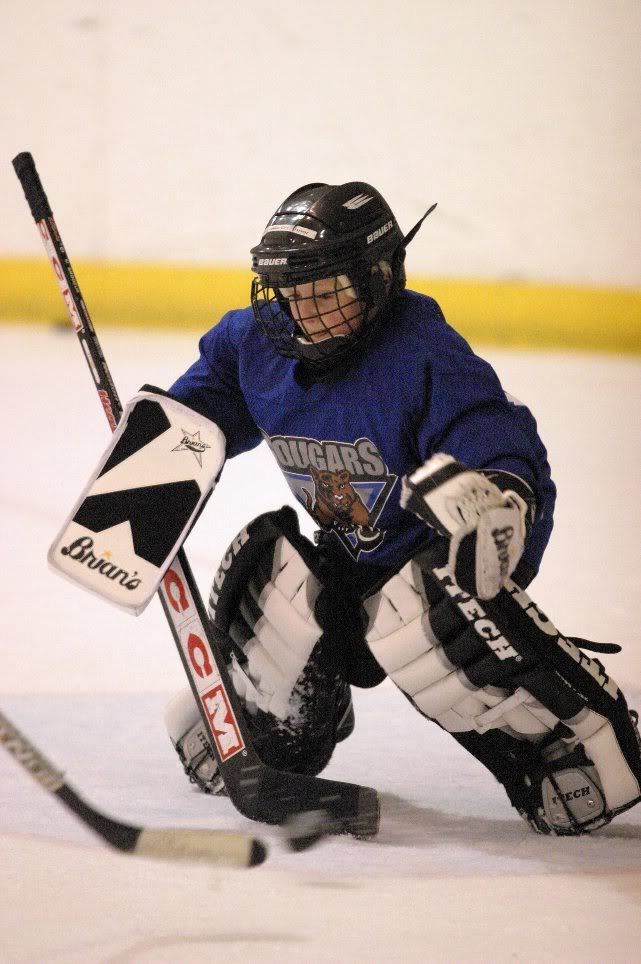
Watch that five-hole, little guy!
The instructor, Paul "Wilkie" Wilkinson, has been playing since age five and was at one time a deprecatingly self-described "door-opener" in the big leagues (read: perennial backup goaltender who sits by the bench door and doesn't play unless the first-string netminder is out). Seems like a good guy who really likes the sport and wants to help us out; still, I don't expect him to be a miracle-worker with me, the guy only has seven combined hours to play goalie doctor and he has eleven other puck-targets to work with. He does seem to have things organized, though; lesson plans have been promised before each day's session and some time off the ice afterwards to discuss drills , skills, and what have you.
First day was pretty general; we split up into four groups of three for some basic stick deflection drills (shooters shoot low to each side and goalie has to redirect the puck to the corner, then shooters shoot high and the goalie has to catch, drop, and redirect on the glove side or redirect in the air on the blocker side). After that some endurance drills that left me a little out of breath by the end of it; nothing like five quick up-and-down butterfly saves followed by a sprint to the center red-line and another up-and-down butterfly cycle.
At the end of the session we divided the group in half and started doing shootouts, with the shooters skating in on the goalie in net and endeavoring to score. As long as the goalie kept turning pucks away he could stay; once one got by, he's out and time for the next guy to test his mettle against the encroaching snipers. I did pretty well on this; during my two stints in net i turned away about three or four each time , either through an active save or playing my angles/depth well enough to force shots wide.
After the session, Wilkie said he'd like to be able to learn more about each of us and to that end we could send him an email about our backgrounds and desired goals for the camp. He may have regretted making that offer as I put together a mammoth 1,955 word essay on my background, perceived strengths/weaknesses, and goals; he's yet to respond, hopefully due more to lax e-mail checking than to me having freaked him out with my enthusiasm.
Will post updates as the weeks (and my l33t g0ali3 ski11z) progress.
Wednesday, April 05, 2006
People on the Internets are shouting at me!
the company i work for is fairly progressive i'd say, one good example being that the office embraces and encourages the use of instant messaging as one method of intraoffice communication. (this may not seem so advanced to people in the tech industry but it's miles ahead of my last employer, which was large enough in size to really benefit from it)
now i've been IM'ing since my later years in college, going on about six years now, and consider myself a pretty civilized IM'er. sure, i've picked up the normal habits like scattershot capitalization of the first letters of names and words at the beginning of sentences, but the departures from the more rigid formal letter format are fairly benign in the realm of everyday conversation; most importantly i remain conscious of what i'm typing to people and how i'm typing it.
some people at this office, though, SEEM TO HAVE THE COMPULSION TO YELL AT ME BY TYPING IN CAPS LOCK ALL THE TIME. SINCE 99% OF THE CONVERSATIONS IN WHICH THEY ARE TYPING IN THIS MANNER ARE NOT DISCUSSIONS OF AN ANGRY NATURE, I CAN ONLY ASSUME THAT THE OTHER SIDE OF THEIR CONVERSATION/OFFICE-WORK MULTITASKING IS SOME SPREADSHEET OR SOMETHING IN WHICH THE FORMAT FOR ENTRIES IS ALL-CAPS; I CAN ASSUME THIS BECAUSE I MYSELF SOMETIMES WORK IN REPORTS AND SCREENS THAT, AS OFFICE CUSTOM DICTATES, REQUIRE USE OF ALL-CAPS TYPING TO MAKE THINGS LOOK NICE AND UNIFORM.
WHERE I GET MY SENSE OF MORAL SUPERIORITY HERE IS THAT I have the presence of mind and dexterity of digit to hit the Caps Lock button and revert to lower-case letters when typing in an IM window to a coworker or friend; when i'm finished typing 'hehe, no shit? lol that r0xoRz' to my friend i can easily tap the Caps Lock button to return to my work screen and enter "RECLASS FUNDS TO PREPAID ACCOUNT".
Whether it's a case of my shouting coworkers not grasping the concept of 'yelling' on IM or if they're simply too lazy to Caps-lock and Caps-unlock, I'LL NEVER KNOW BUT IT GRINDS ON MY LAST NERVE I THINK I WILL GO APE-POOP IF THEY KEEP DOING IT TO ME YEARRGGGGHGHH
now i've been IM'ing since my later years in college, going on about six years now, and consider myself a pretty civilized IM'er. sure, i've picked up the normal habits like scattershot capitalization of the first letters of names and words at the beginning of sentences, but the departures from the more rigid formal letter format are fairly benign in the realm of everyday conversation; most importantly i remain conscious of what i'm typing to people and how i'm typing it.
some people at this office, though, SEEM TO HAVE THE COMPULSION TO YELL AT ME BY TYPING IN CAPS LOCK ALL THE TIME. SINCE 99% OF THE CONVERSATIONS IN WHICH THEY ARE TYPING IN THIS MANNER ARE NOT DISCUSSIONS OF AN ANGRY NATURE, I CAN ONLY ASSUME THAT THE OTHER SIDE OF THEIR CONVERSATION/OFFICE-WORK MULTITASKING IS SOME SPREADSHEET OR SOMETHING IN WHICH THE FORMAT FOR ENTRIES IS ALL-CAPS; I CAN ASSUME THIS BECAUSE I MYSELF SOMETIMES WORK IN REPORTS AND SCREENS THAT, AS OFFICE CUSTOM DICTATES, REQUIRE USE OF ALL-CAPS TYPING TO MAKE THINGS LOOK NICE AND UNIFORM.
WHERE I GET MY SENSE OF MORAL SUPERIORITY HERE IS THAT I have the presence of mind and dexterity of digit to hit the Caps Lock button and revert to lower-case letters when typing in an IM window to a coworker or friend; when i'm finished typing 'hehe, no shit? lol that r0xoRz' to my friend i can easily tap the Caps Lock button to return to my work screen and enter "RECLASS FUNDS TO PREPAID ACCOUNT".
Whether it's a case of my shouting coworkers not grasping the concept of 'yelling' on IM or if they're simply too lazy to Caps-lock and Caps-unlock, I'LL NEVER KNOW BUT IT GRINDS ON MY LAST NERVE I THINK I WILL GO APE-POOP IF THEY KEEP DOING IT TO ME YEARRGGGGHGHH
Subscribe to:
Posts (Atom)